Publications
2026
- Preprint
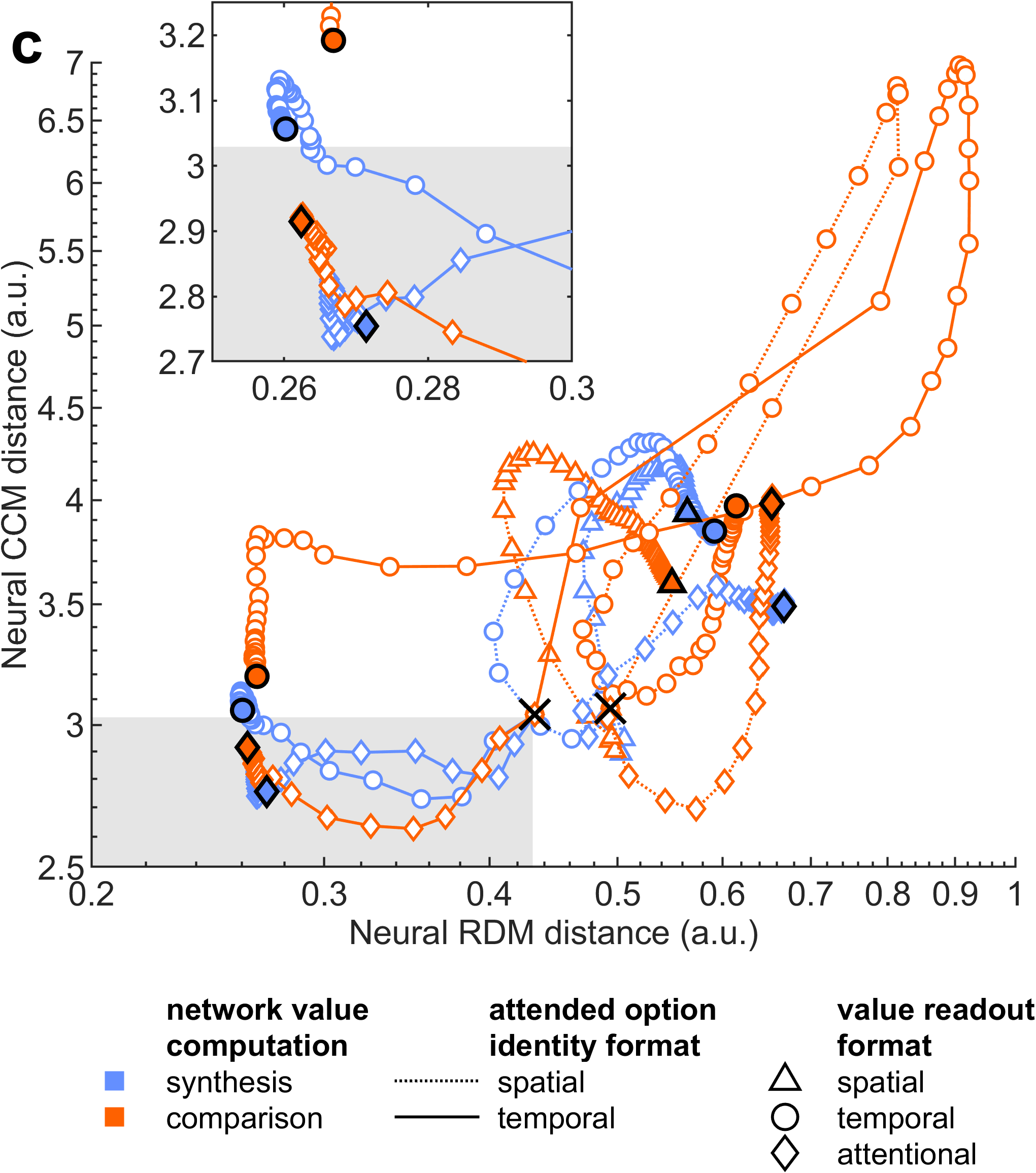 Irrational decisions reflect robustness constraints on value computations implemented by orbitofrontal circuitsbioRxiv, May 2026
Making good decisions is essential for survival and success, yet humans and animals often exhibit perplexing irrational decision-making whose biological origin remains poorly understood. Recent empirical and computational work suggests that altered computations in perceptual, motor and memory systems in the brain may arise from informational, metabolic or robustness constraints on their internal connectivity structure. However, whether and how such neurobiological constraints may have molded the architecture of decision systems (such as the orbitofrontal cortex) and eventually distorted decision-relevant computations, remains largely unknown. We first train cohorts of artificial neural nets to perform ten variants of rational decision-relevant computations. Those variants that operate under a specific option-encoding format exhibit most of the electrophysiological coding properties observed in orbitofrontal neurons of monkeys making decisions under risk. We then distort these neural nets’ internal wiring to reproduce monkeys’ irrational choices. This induces deterministic spillover interferences in decision-relevant computations that generalize across individuals, at both the behavioral and neural level. Importantly, although irrational nets do not seem to bring informational or metabolic benefits, they display enhanced tolerance to damage and noise when compared to their rational counterparts. This suggests that some forms of irrational behavior may be the incidental outcome of distal evolutionary pressure on the robustness of orbitofrontal circuits.
@article{benon_2026_irrational,
  title = {Irrational decisions reflect robustness constraints on value computations implemented by orbitofrontal circuits},
  url = {https://www.biorxiv.org/content/10.1101/2025.07.10.664081v2},
  doi = {10.1101/2025.07.10.664081},
  language = {en},
  urldate = {2026-05-25},
  journal = {bioRxiv},
  author = {Bénon, Juliette and Pessiglione, Mathias and Vinckier, Fabien and Daunizeau, Jean},
  month = may,
  year = {2026},
}

2025
- PhD Thesis
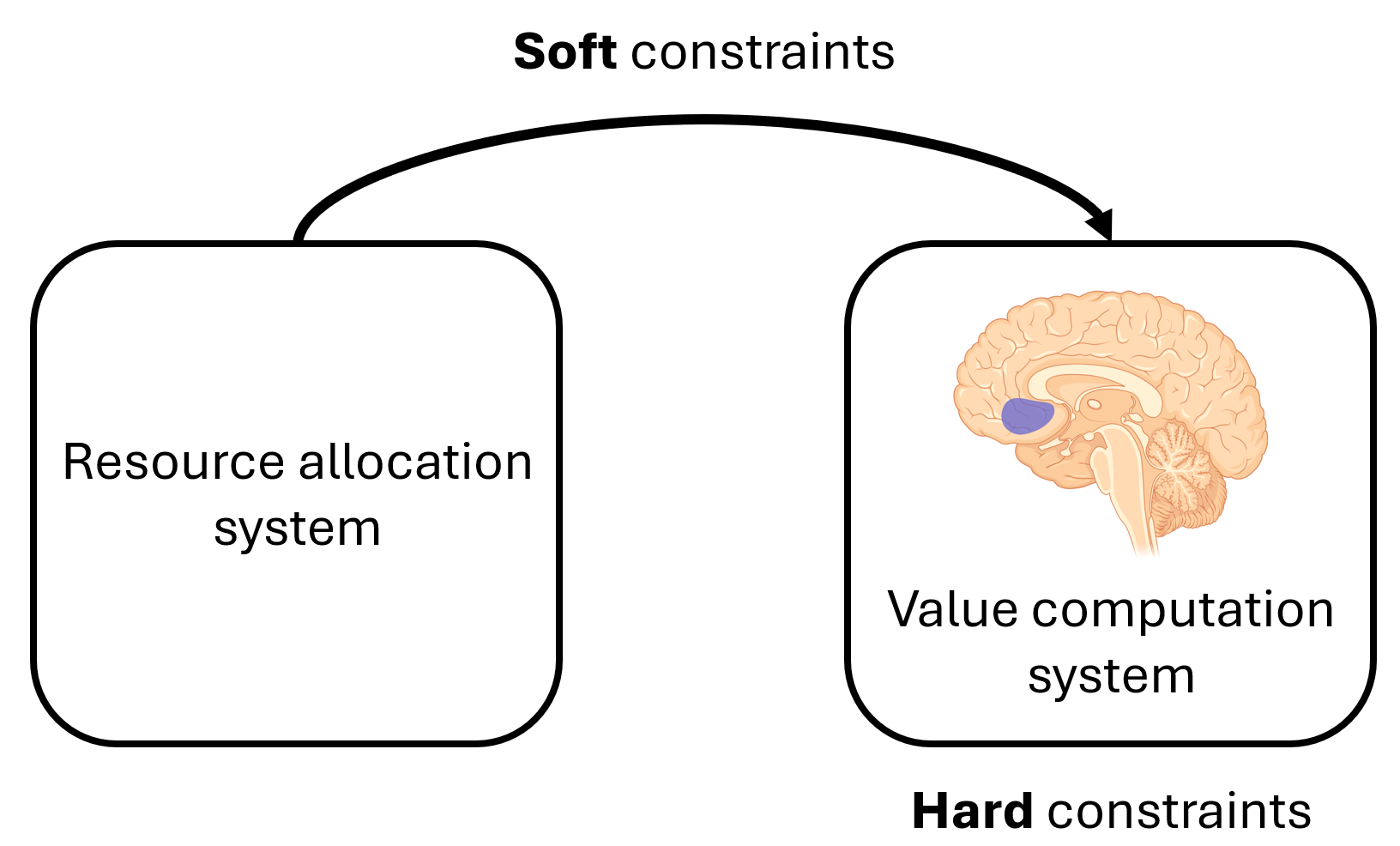 A neuro-computational account of rationality costs in decision-makingJuliette BénonSep 2025
In hindsight, our decisions can sometimes seem odd, ill-judged, or even outright terrible. Why did you suddenly take that dare to sing karaoke? Was it worth buying twenty bars of chocolate that were on sale? And why send that message after an all-nighter? A moment of introspection may offer some insight. Perhaps you felt time pressure, were caught up in the thrill of the moment, or were so certain to have a deal that you didn’t think any further. These situations are, of course, part of being human: everyone makes mistakes. But why, exactly? When it comes to our own choices, ne might assume that we know our tastes and preferences well enough to avoid these mishaps. Theories of cognition suggest otherwise. Our mental capacities are limited, and these limitations shape nearly every aspect of our behaviour. Just as we cannot remember everything we have experienced, we struggle to read while someone is speaking or to multiply four-digit numbers in our head. These constraints also influence decision-making, sometimes leading to irrational choices. Yet, thinking more carefully can help us reduce such mistakes. This is the focus of my dissertation. My aim is to understand the computational principles that underlie irrational decision-making. I approached this issue from the hypothesis that decision-making is biologically costly, and that irrational behaviours may emerge from adaptive trade-offs between behavioural efficiency and biological limitations. First, I investigated why decision-relevant computations may be rushed or prematurely halted. I developed a computational model that formalises deliberation as an optimal stopping problem, in which mental resources are allocated by balancing expected gains in confidence against the costs of mental effort. This model predicts the non-trivial tripartite relationship between response time, decision rationality, and confidence. Second, I explored whether irrational choices — that arise even when mental effort costs are low — may result from architectural constraints in neural systems involved in decision-relevant computations. I trained recurrent artificial neural networks to perform value-based decisions under two regimes: a rational one, which maximises expected reward rate, and an irrational one, which replicates empirically observed suboptimal choices. A subset of rational networks spontaneously developed internal representations resembling those of orbitofrontal cortex (OFC) neurons. Interestingly, their irrational counterparts exhibited an even stronger resemblance to OFC activity, supporting their validity as biologically plausible models. Moreover, these irrational networks were more resilient to neural loss than their rational counterparts, suggesting that the architecture of OFC networks may have evolved under selective pressure for biological robustness — at the cost of slight irrationality. Together, these contributions support the view that irrational behaviour reflects adaptive responses to structural and computational constraints that are inherent to biological systems.
@phdthesis{benon_2025_thesis,
  title = {{A neuro-computational account of rationality costs in decision-making}},
  author = {Bénon, Juliette},
  url = {https://theses.hal.science/tel-05327543},
  number = {2025SORUS230},
  school = {{Sorbonne Université}},
  year = {2025},
  month = sep,
  doi = {10.70675/48e843dezb278z425bzbddaz454485824c6d},
  type = {Doctoral dissertation},
}

2024
- Peer-reviewed
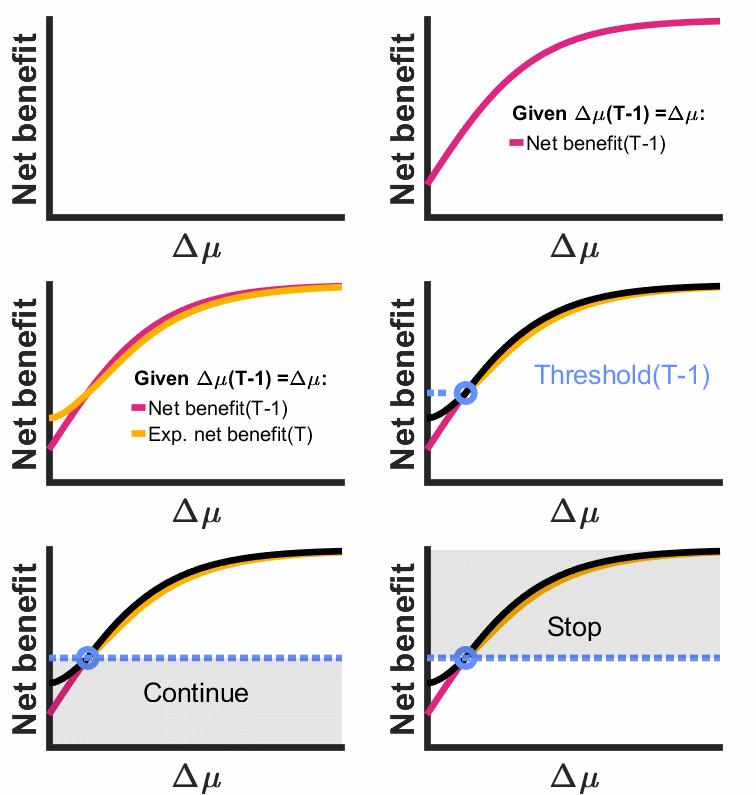 The online metacognitive control of decisionsJuliette Bénon, Douglas Lee, William Hopper, Morgan Verdeil, Mathias Pessiglione, Fabien Vinckier, Sébastien Bouret, Marion Rouault, Raphaël Le Bouc, Giovanni Pezzulo, Christiane Schreiweis, Éric Burguière, and Jean DaunizeauCommunications Psychology, Mar 2024
Difficult decisions typically involve mental effort, which scales with the deployment of cognitive (e.g., mnesic, attentional) resources engaged in processing decision-relevant information. But how does the brain regulate mental effort? A possibility is that the brain optimizes a resource allocation problem, whereby the amount of invested resources balances its expected cost (i.e. effort) and benefit. Our working assumption is that subjective decision confidence serves as the benefit term of the resource allocation problem, hence the “metacognitive” nature of decision control. Here, we present a computational model for the online metacognitive control of decisions or oMCD. Formally, oMCD is a Markov Decision Process that optimally solves the ensuing resource allocation problem under agnostic assumptions about the inner workings of the underlying decision system. We demonstrate how this makes oMCD a quasi-optimal control policy for a broad class of decision processes, including -but not limited to- progressive attribute integration. We disclose oMCD’s main properties (in terms of choice, confidence and response time), and show that they reproduce most established empirical results in the field of value-based decision making. Finally, we discuss the possible connections between oMCD and most prominent neurocognitive theories about decision control and mental effort regulation.
@article{benon_2024_online,
  title = {The online metacognitive control of decisions},
  volume = {2},
  issn = {2731-9121},
  url = {https://www.nature.com/articles/s44271-024-00071-y},
  doi = {10.1038/s44271-024-00071-y},
  language = {en},
  number = {1},
  urldate = {2024-03-28},
  journal = {Communications Psychology},
  author = {Bénon, Juliette and Lee, Douglas and Hopper, William and Verdeil, Morgan and Pessiglione, Mathias and Vinckier, Fabien and Bouret, Sébastien and Rouault, Marion and Le Bouc, Raphaël and Pezzulo, Giovanni and Schreiweis, Christiane and Burguière, Éric and Daunizeau, Jean},
  month = mar,
  year = {2024},
  pages = {1--17},
}
